
The largest intergenerational wealth transfer in human history is creating unprecedented opportunities for women to reshape the financial landscape. Over the next two decades, an estimated $84.4 trillion in assets will pass from Baby Boomers and the Silent Generation to younger generations¹. However, the most significant development may not be what moves down through generations, but what first moves horizontally within them; from aging male Boomers to their wives, creating a two-step transfer phenomenon that positions women to control more financial resources than ever before.
This demographic shift occurs precisely as women demonstrate distinct investment preferences that prioritize environmental, social, and governance (ESG) factors, long-term value creation, and sustainable impact. The convergence of massive wealth concentration with evolving investment philosophies represents a transformation that extends far beyond simple asset redistribution; it signals a fundamental reimagining of how capital markets will operate in the coming decades.
The Two-Step Transfer: Understanding the Demographic Reality
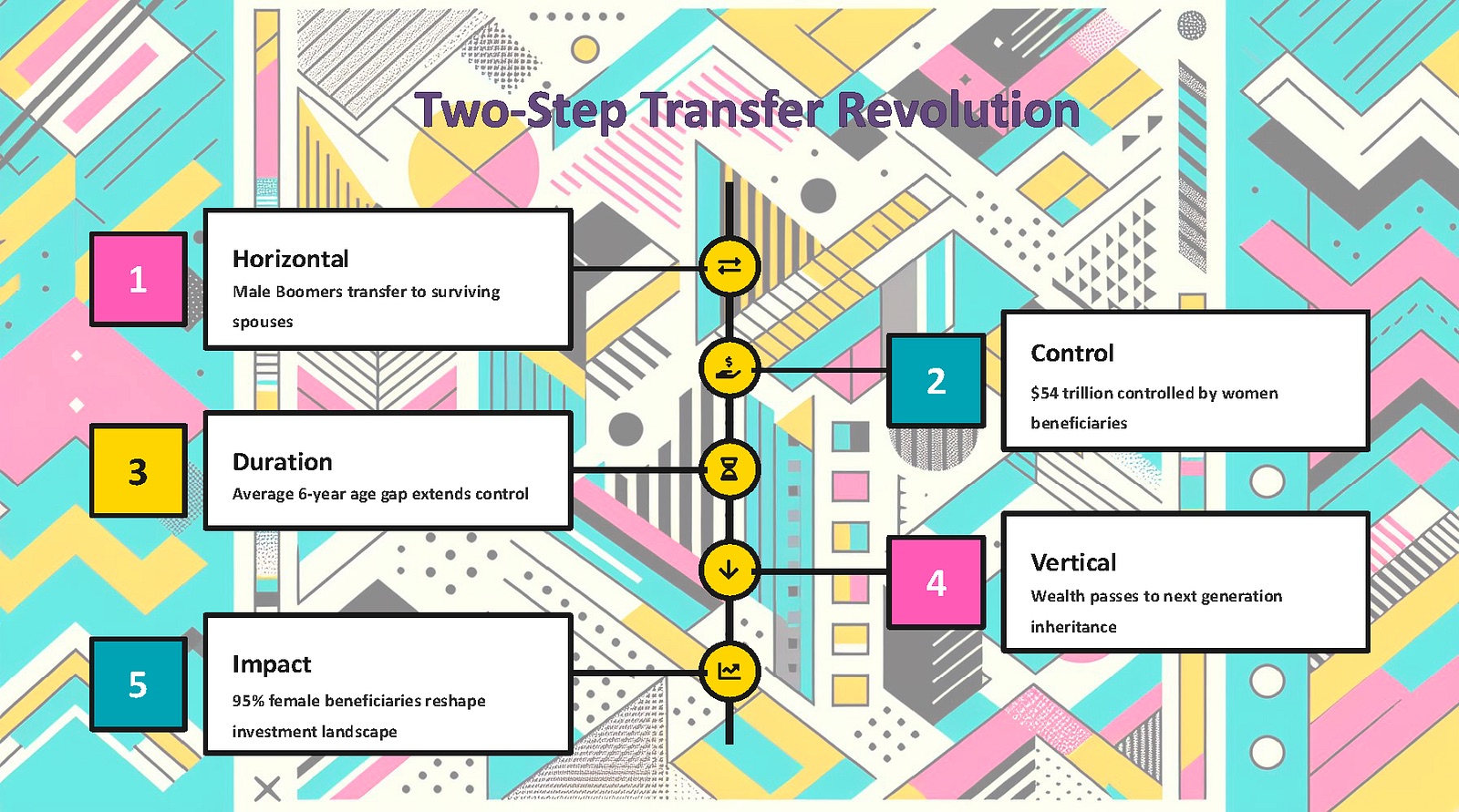
The Great Wealth Transfer unfolds as a complex two-phase process that positions women as both immediate and ultimate beneficiaries. Research published in JAMA Internal Medicine reveals that “as male baby boomers die, they will leave their assets to their wives, who are typically younger, with more years ahead of them, six years on average”². This creates what financial professionals now recognize as the “horizontal wealth transfer,” where assets first move between spouses within the same generation before eventually passing to children and grandchildren.
The scale of this horizontal transfer is staggering. Bank of America Institute research indicates that roughly $54 trillion will go to surviving spouses, and among this group, 95% are women³. This statistic reflects both the longer life expectancy of women and the typical age gap in marriages where men tend to be older. For many women, this represents their first experience as primary financial decision-makers, having previously deferred investment choices to their spouses.
According to Cerulli Associates data, the full intergenerational breakdown shows Gen X inheriting an estimated $39 trillion, Millennials receiving $46 trillion, and Gen Z expecting $15 trillion⁴. However, the pathway to these inheritances increasingly flows through women who will manage these assets for significant periods. UBS research demonstrates that Baby Boomers currently hold around 70% of investable assets in affluent U.S. households, with roughly 30% more married women now managing their household finances compared to five years ago⁵.
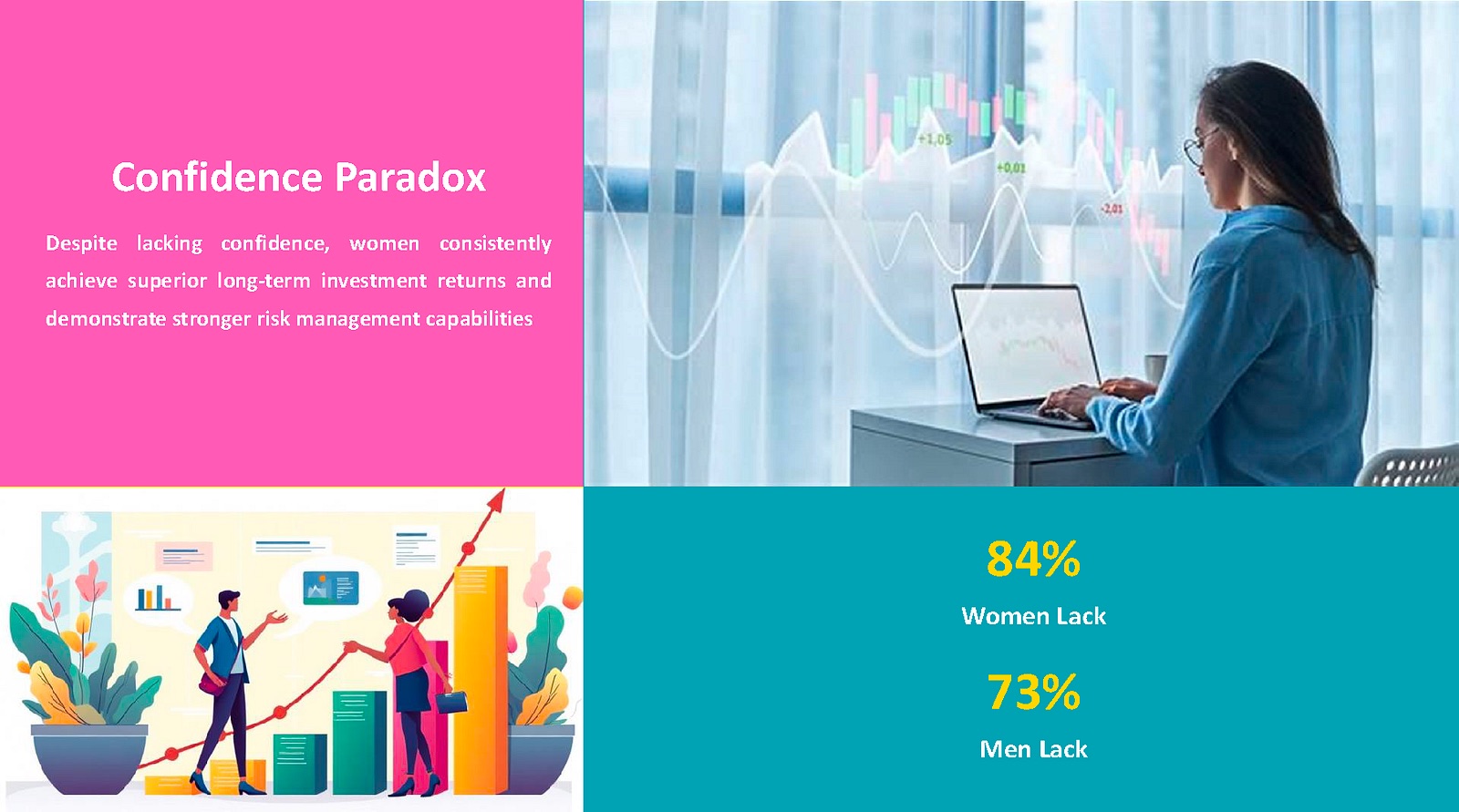
The timing creates unique challenges and opportunities. Many women suddenly find themselves managing substantial portfolios without having participated in the initial wealth creation or investment decision-making process. Citizens Bank research reveals that 84% of women say they lack confidence in their ability to manage an inheritance or other financial windfall, compared to 73% of men⁶. This confidence gap exists despite evidence that women often excel at long-term planning and risk-adjusted investment strategies.
Women’s Distinct Investment Philosophy: Beyond Financial Returns
Women’s approach to wealth management differs significantly from traditional male-dominated investment strategies, with implications that extend far beyond individual portfolio construction. These differences are not merely preferences; they represent fundamental philosophical approaches to capital allocation that prioritize long-term value creation and societal impact alongside financial returns.
ESG and sustainable investing emerge as primary areas where women demonstrate distinct preferences. UBS research indicates that 71% of women take sustainability into account when choosing their investments, compared to 58% of men⁷. This gap reflects deeper value systems that prioritize environmental stewardship, social responsibility, and corporate governance quality as integral components of investment decision-making.
RBC Wealth Management findings demonstrate that women are more than twice as likely as men to say it’s extremely important that the companies they invest in incorporate ESG factors into their policies and procedures⁸. This preference extends beyond simple screening to active engagement with companies on sustainability practices and long-term value creation. Women are 64% likely to always consider environmental, social, and governance factors in their investment decisions⁹, suggesting systematic integration rather than occasional consideration.
The impact philosophy extends to specific investment themes. Research shows that 84% of gender-lens investors also target climate solutions¹⁰, recognizing the interconnectedness of social justice and environmental challenges. Among ESG themes most important to women investors are companies that pay workers fair wages and demonstrate leading environmental responsibility¹¹.
Women’s investment preferences also emphasize education, transparency, and long-term planning. Morgan Stanley research reveals that 77% of individual investors globally are interested in sustainable investing, with 57% indicating their interest has increased in the last two years¹². Women drive much of this growth, seeking investments that align with personal values while generating market-rate returns.
The preference for impact extends to specific asset allocation decisions. Survey data shows that 24% of women have directed their extra savings toward ESG and sustainable investments, with 59% expressing interest in selecting investments more closely aligned with their values¹³. This systematic approach to value-based investing represents a significant departure from traditional return-focused strategies.
Financial Confidence and Decision-Making Patterns
Despite holding significant financial resources, women face persistent confidence gaps that create both challenges and opportunities for the financial services industry. Understanding these patterns becomes crucial as women assume primary responsibility for unprecedented wealth levels.
Global research by BNY Mellon found that only 28% of women feel confident about investing some of their money¹⁴. McKinsey reported that only a quarter of affluent women said they were comfortable making investment and savings decisions alone, compared to 40% of men¹⁵. These confidence gaps persist despite evidence that women often achieve superior risk-adjusted investment returns through longer holding periods and more disciplined approaches to portfolio management.
The confidence gap stems partially from historical exclusion from financial decision-making. Citizens Bank research reveals that only 49% of women surveyed had opened their own investment account, compared to two-thirds of men¹⁶. This experiential deficit creates initial hesitation, but research suggests confidence improves dramatically with involvement and education.
Receiving a transfer of wealth nearly doubles women’s financial confidence to the point where they become more confident about their ability to manage money than men¹⁷. This transformation suggests that access to resources, combined with appropriate support and education, can rapidly bridge confidence gaps while unleashing sophisticated investment decision-making capabilities.
Women’s approach to financial advisory relationships also differs significantly. 90% of women communicate a desire to work with a financial advisor to meet their goals¹⁸, but they seek advisors who provide both sound financial advice and educational support. Nearly half of women (43%) want advisors who play dual roles as financial coaches and counselors¹⁹.
The relationship preferences reflect deeper communication styles. Women typically focus on life goals and security rather than benchmark performance²⁰, requiring advisory approaches that address holistic financial wellness rather than purely transactional investment management. They are more likely to consider alternatives when introduced by advisors who understand their experiences and communication preferences.
Market Structure Transformation and Industry Response
The concentration of wealth among women investors creates market dynamics that will fundamentally reshape financial services delivery, product development, and industry structure. Traditional advisory models designed primarily for male decision-makers prove inadequate for engaging women who prioritize different communication styles, investment themes, and planning approaches.
Current advisory representation creates significant misalignment with client demographics. Despite women controlling nearly a third of global wealth, only 15–20% of financial advisors are women²¹. Even fewer specialize in alternative investments or sustainable investing strategies that women prioritize. This representation gap becomes more problematic as women assume primary decision-making roles for inherited wealth.
Advisory relationship patterns reveal systemic issues with current service models. Common wisdom among financial advisors suggests that 70% of widows switch to new financial institutions after their spouse’s death²². This switching rate reflects dissatisfaction with advisory relationships that failed to engage women as equal participants in financial planning processes.
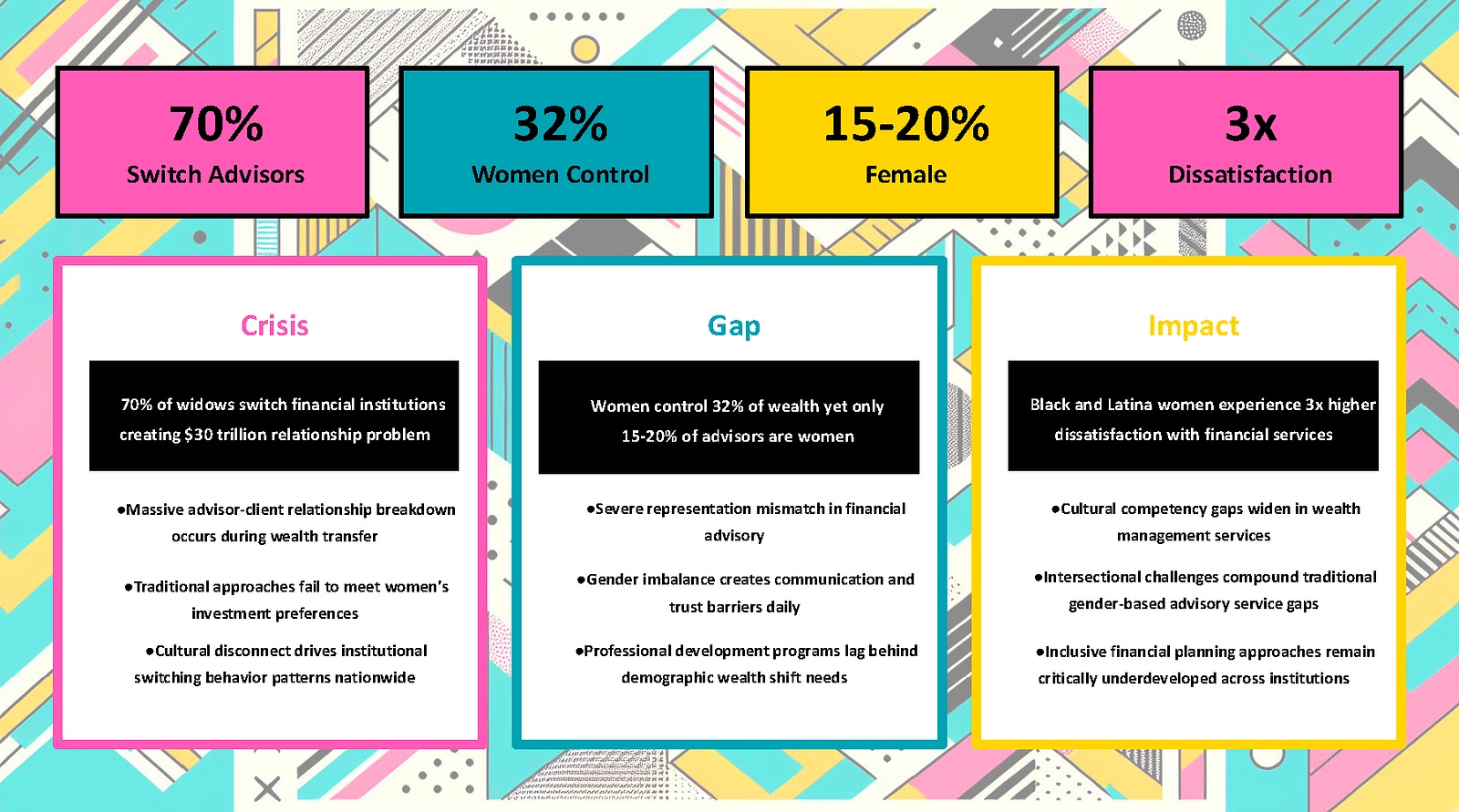
The frustration is particularly pronounced among diverse populations. Black and Latina women are three times as likely as White women to say financial services do not fit their needs²³. This disparity suggests that cultural competency and inclusive service delivery will become competitive advantages as wealth concentration among women increases across demographic groups.
Women’s increasing economic influence drives demand for new financial products and services. Women now control 32% of global wealth, a figure that continues to grow²⁴. By 2030, women are expected to control 38% of investable assets; representing $30 trillion in financial power²⁵. This growth creates market opportunities for institutions that develop specialized expertise in women-focused wealth management.
The product development implications extend beyond traditional investment management. Women’s preferences for ESG integration, educational support, and values-based investing drive demand for sophisticated platforms that combine traditional investment capabilities with impact measurement, sustainability reporting, and educational resources.
Generational Differences and Evolution
Understanding generational differences among women investors becomes crucial as different age cohorts assume financial decision-making responsibilities with distinct preferences, experiences, and expectations.
Baby Boomer women often have limited experience as primary financial decision-makers, having deferred investment choices to their spouses throughout their marriages. For these women, inheriting responsibility for substantial portfolios represents a dramatic life transition requiring significant support and education.
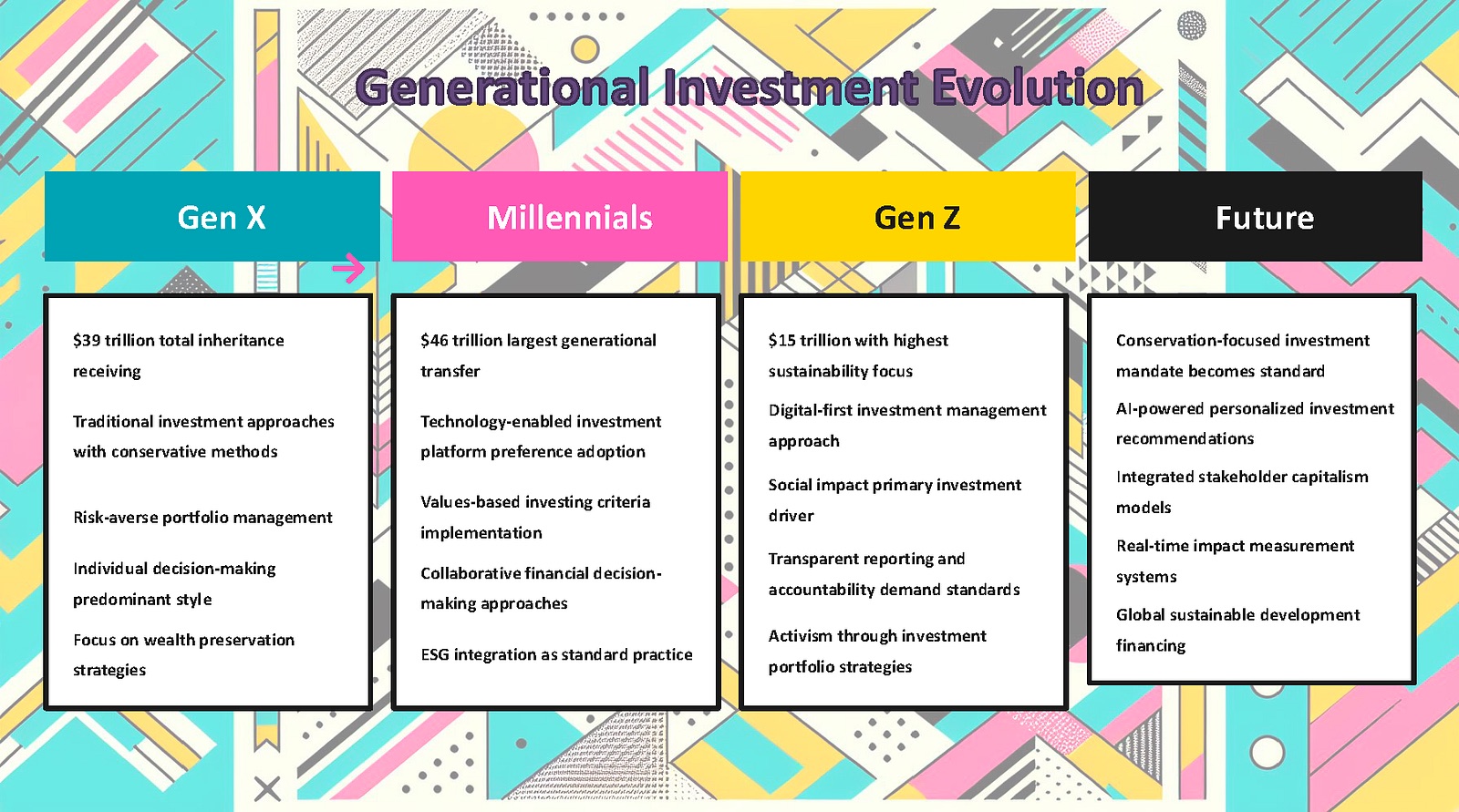
Gen X and Millennial women approach wealth planning more collaboratively, viewing financial management as a joint responsibility and placing high value on financial education, transparency, and participatory decision-making²⁶. These younger women grew up with greater financial independence and career opportunities, creating different expectations for advisory relationships and investment strategies.
Interestingly, some research suggests that wealthy Millennial women are more likely to defer financial decisions to their spouses than Boomer women²⁷, indicating that cultural patterns around financial decision-making remain complex and evolving. This finding suggests that empowerment and confidence do not automatically correlate with generational change, requiring individualized approaches to engagement and education.
Younger women demonstrate greater openness to alternative investment strategies, digital platforms, and innovative financial products. They are more likely to embrace technology-enabled investment management while maintaining strong preferences for personalized advice and educational support.
The generational differences create opportunities for financial institutions to develop specialized service models that address the distinct needs of different age cohorts while recognizing common themes around transparency, education, and values-based investing.
Global Implications and Market Impact
The concentration of wealth among women extends beyond U.S. borders, creating global implications for capital markets, corporate governance, and sustainable development initiatives. Women’s distinct investment preferences will influence capital allocation patterns worldwide as their financial influence grows.
The scale of potential impact becomes clear when considering that the amount of money women will control by 2030 could fund global climate action initiatives. The Global Climate Policy Initiative estimates that addressing climate change requires $8.1 to $9 trillion annually by 2030; just one-tenth of the amount women will control²⁸.
International research confirms that women’s investment preferences transcend national boundaries. Global investors report 77% interest in sustainable investing, with women driving much of the growth in ESG-focused capital allocation²⁹. This global trend suggests that women’s influence on investment markets will create synchronized changes across international financial systems.
Corporate governance will evolve as women’s investment preferences reward companies with strong ESG practices, diverse leadership, and stakeholder-focused business models. Companies that fail to address sustainability concerns or demonstrate inclusive leadership may face capital allocation challenges as women exercise their growing influence over investment decisions.
The philanthropic implications are equally significant. Research indicates that women are more likely to support educational initiatives, healthcare access, and social justice causes through both direct philanthropy and impact investing³⁰. As women control larger financial resources, charitable giving patterns and impact investing flows will likely increase substantially.
Strategic Recommendations for Financial Institutions
Financial services organizations must adapt rapidly to serve women investors effectively while capitalizing on the largest wealth transfer in history. Success requires fundamental changes to advisory models, product development, and organizational culture.
Immediate priorities include expanding female advisor representation and developing specialized expertise in ESG and sustainable investing. Institutions should invest in advisor training programs that address women’s communication preferences, planning priorities, and investment philosophies.
Technology integration becomes essential for serving women investors who demand transparency, education, and values alignment. Digital platforms should provide comprehensive ESG reporting, impact measurement, and educational resources while maintaining human advisory relationships.
Product development should prioritize innovative investment vehicles that combine financial returns with social and environmental impact. This includes expanding alternative investment access, developing gender-lens investing strategies, and creating educational investment products that build confidence while generating returns.
Organizations must also address cultural and operational changes necessary for inclusive service delivery. This includes examining compensation structures, performance metrics, and client engagement practices that may inadvertently exclude or discourage women investors.
Marketing and communication strategies require substantial revision to reflect women’s investment priorities and communication preferences. Traditional performance-focused messaging should evolve to emphasize long-term value creation, impact measurement, and holistic financial wellness.
Conclusion: A New Era of Financial Leadership
The Great Wealth Transfer represents more than demographic change; it signals the emergence of a new era in financial leadership characterized by values-based investing, long-term thinking, and stakeholder-focused capitalism. Women’s growing control over financial resources will fundamentally reshape how capital markets operate, how companies approach governance and sustainability, and how financial institutions serve their clients.
The $84 trillion transfer creates unprecedented opportunities for financial institutions that position themselves effectively to serve women investors. Organizations that invest in inclusive advisory models, sustainable investment products, and educational resources will capture disproportionate value as wealth concentration among women accelerates.
The transformation extends beyond individual portfolio management to encompass systemic changes in corporate behavior, sustainable development funding, and social impact investing. Women’s distinct investment preferences will drive capital toward companies and initiatives that prioritize long-term value creation over short-term returns.
The window for competitive advantage remains open, but institutions must act decisively to build capabilities and relationships that serve women investors effectively. Those that delay adaptation will find themselves increasingly disconnected from the most significant wealth management opportunity in history.
As women assume primary responsibility for unprecedented financial resources, their influence will reshape global capital markets while advancing sustainable development goals that benefit society broadly. The Great Wealth Transfer represents not just an inheritance of assets, but an inheritance of responsibility for creating a more inclusive, sustainable, and equitable financial future.
References
- World Economic Forum. (2024, July). The ‘Great Wealth Transfer’: Here’s how women can make the most of it. Retrieved from https://www.weforum.org/stories/2024/07/women-inheritance-great-wealth-transfer/
- Washington Post. (2024, January 16). The wealth transfer from baby boomers mostly benefits women. Retrieved from https://www.washingtonpost.com/business/2024/01/16/women-economic-power-demographic-shifts/
- CNBC. (2025, March 12). Women will get most of the $124 trillion ‘great wealth transfer,’ studies show. Retrieved from https://www.cnbc.com/2025/03/12/most-of-the-124-trillion-great-wealth-transfer-will-go-to-women.html
- Merrill Lynch. (2023, October 3). How Will the Great Wealth Transfer Impact the Markets? Retrieved from https://www.ml.com/articles/great-wealth-transfer-impact.html
- Trella. (2024). The Great Horizontal Wealth Transfer: A New Chapter in Financial Legacy. Retrieved from https://www.trella.ca/post/the-great-horizontal-wealth-transfer-a-new-chapter-in-financial-legacy
- Citizens Bank. (2025). The Great Wealth Transfer and the Future of Women’s Wealth. Retrieved from https://www.citizensbank.com/learning/great-wealth-transfer-women-shaping-financial-future.aspx
- Moneywise. (2024). Women and Investing in 2024: Latest Statistics. Retrieved from https://moneywise.com/investing/investing-for-women
- RBC Wealth Management. (2023, November 1). As women gain power, interest in ESG investing grows. Retrieved from https://www.rbcwealthmanagement.com/en-us/insights/as-women-gain-power-interest-in-esg-investing-grows
- CAIA Association. (2025, April). The Great Wealth Transfer — An Opportunity for Female Financial Advisors. Retrieved from https://caia.org/content/april-2025-great-wealth-transfer-opportunity-female-financial-advisors
- CAIA Association. (2025, April). The Great Wealth Transfer — An Opportunity for Female Financial Advisors. Retrieved from https://caia.org/content/april-2025-great-wealth-transfer-opportunity-female-financial-advisors
- RBC Wealth Management. (2023, November 1). As women gain power, interest in ESG investing grows. Retrieved from https://www.rbcwealthmanagement.com/en-us/insights/as-women-gain-power-interest-in-esg-investing-grows
- Morgan Stanley. (2024). Sustainable Investment Interest on the Rise in 2024. Retrieved from https://www.morganstanley.com/ideas/sustainable-investing-on-the-rise
- CNBC. (2021, November 10). Op-ed: The future of socially responsible investing is in female hands. Retrieved from https://www.cnbc.com/2021/11/10/op-ed-the-future-of-socially-responsible-investing-is-in-female-hands.html
- CAIA Association. (2025, April). The Great Wealth Transfer — An Opportunity for Female Financial Advisors. Retrieved from https://caia.org/content/april-2025-great-wealth-transfer-opportunity-female-financial-advisors
- Washington Post. (2024, January 16). The wealth transfer from baby boomers mostly benefits women. Retrieved from https://www.washingtonpost.com/business/2024/01/16/women-economic-power-demographic-shifts/
- Citizens Bank. (2025). The Great Wealth Transfer and the Future of Women’s Wealth. Retrieved from https://www.citizensbank.com/learning/great-wealth-transfer-women-shaping-financial-future.aspx
- Ellevest. (2024). Why the Great Wealth Transfer Is Making History for Women and Wealth. Retrieved from https://www.ellevest.com/magazine/investing/great-wealth-transfer
- Citizens Bank. (2025). The Great Wealth Transfer and the Future of Women’s Wealth. Retrieved from https://www.citizensbank.com/learning/great-wealth-transfer-women-shaping-financial-future.aspx
- Citizens Bank. (2025). The Great Wealth Transfer and the Future of Women’s Wealth. Retrieved from https://www.citizensbank.com/learning/great-wealth-transfer-women-shaping-financial-future.aspx
- InvestmentNews. (2025, January). Great Wealth Transfer: Why advisors better get ready for more women with money. Retrieved from https://www.investmentnews.com/ria-news/great-wealth-transfer-why-advisors-better-get-ready-for-more-women-with-money/261311
- CAIA Association. (2025, April). The Great Wealth Transfer — An Opportunity for Female Financial Advisors. Retrieved from https://caia.org/content/april-2025-great-wealth-transfer-opportunity-female-financial-advisors
- Washington Post. (2024, January 16). The wealth transfer from baby boomers mostly benefits women. Retrieved from https://www.washingtonpost.com/business/2024/01/16/women-economic-power-demographic-shifts/
- Washington Post. (2024, January 16). The wealth transfer from baby boomers mostly benefits women. Retrieved from https://www.washingtonpost.com/business/2024/01/16/women-economic-power-demographic-shifts/
- CAIA Association. (2025, April). The Great Wealth Transfer — An Opportunity for Female Financial Advisors. Retrieved from https://caia.org/content/april-2025-great-wealth-transfer-opportunity-female-financial-advisors
- CAIA Association. (2025, April). The Great Wealth Transfer — An Opportunity for Female Financial Advisors. Retrieved from https://caia.org/content/april-2025-great-wealth-transfer-opportunity-female-financial-advisors
- InvestmentNews. (2025, January). Great Wealth Transfer: Why advisors better get ready for more women with money. Retrieved from https://www.investmentnews.com/ria-news/great-wealth-transfer-why-advisors-better-get-ready-for-more-women-with-money/261311
- Ellevest. (2024). Why the Great Wealth Transfer Is Making History for Women and Wealth. Retrieved from https://www.ellevest.com/magazine/investing/great-wealth-transfer
- Ellevest. (2024). Why the Great Wealth Transfer Is Making History for Women and Wealth. Retrieved from https://www.ellevest.com/magazine/investing/great-wealth-transfer
- Morgan Stanley. (2024). Sustainable Investment Interest on the Rise in 2024. Retrieved from https://www.morganstanley.com/ideas/sustainable-investing-on-the-rise
- RBC Wealth Management. (2023, November 1). As women gain power, interest in ESG investing grows. Retrieved from https://www.rbcwealthmanagement.com/en-us/insights/as-women-gain-power-interest-in-esg-investing-grows